Thursday, April 1, 2021

April 01, 2021 - No comments

Traveling and Camping By Motorcycle In Europe in 1977

 This is a work-in-progress, I'll be adding more later :-)

After I was separated from the U.S. Navy in April 1977 at the base at RAF Edzell in Scotland, I spent a month camping in Scotland, and visiting the Isle of Skye with Bruce, a Navy friend that also had a BMW R90/6 motorcycle.  

On the Corran Ferry crossing Loch Linnhe from Nether Lochaber to Ardgour, south of Fort William, on an indirect route to the Isle of Skye.


Then 4 of us from the Navy at Edzell rode and camped on the Isle of Man for the late-May TT Motorcycle races.


Above - Bruce Wheeler at the IoM TT races


 Later in May I packed up the bike for a 5 month trip and left Scotland, heading south to England where I took a ferry from Dover to Calais, France.  I started riding and camping north to Scandinavia.  Getting to the Nordkapp (North Cape) of Norway, way over the Arctic Circle and the farthest point north you can get to in Europe, was my goal :-)  The Nordkapp was 900 miles NORTH of the Arctic Circle, driving by (mostly gravel) road !

Bike packed on the day I left Marykirk, Scotland on my trip around Europe

My DX adventure that summer took me through 23 DXCC countries via motorcycle. I met many hams along the way, stopping whenever I saw big antennas, and rode 45,000 miles (72,500 km) on the BMW in Europe and Great Britain.


 While riding north up the Norwegian coast in 1977, one place I camped in was Tromso, Norway above the Arctic Circle.  I was getting low on money (VERY low, only $10 or so left) and called my parents in Minnesota on the telephone to WIRE me some of my money that was in a joint bank account with them. I had already talked to the local bank manager and I gave my parents all the bank info.  Every day for a week I went to the bank in the afternoon to see if they had my money, after a few days everyone there knew who I was :-)  Day after day, never any money, I had run out and was getting really worried, until finally it showed up at the bank in the MAIL. My mom later told me they mailed it to save the bank wire fees, but I was out of money for a week while waiting for it! 

When I was hanging around Tromso with no money I met a German and his girlfriend, also riding a BMW motorcycle.  They told me about a local motorcycle club HMCK that had a clubhouse (Harry MC Klub, named after Harry the club founder).  I could stay there for free for a few days, the German couple had stayed at the clubhouse for the night. The club members didn't live there but did party at night, they were friendly and it was great that they let me stay there for a week! 


With much of Norway, Sweden and Finland remote and forested it was easy to find places to camp free most of the summer, although I was chased away once in Sweden.  Sweden is a very organized and regimented country and didn't have the same laws or traditions as Norway and Finland when it came to public use of forests (or Scotland and England, for that matter).  I continued riding and camping north.  The road across the open tundra was made of crushed rock, about the size of a baseball.  Even with the steering damper of the bike on maximum the road was so rough that I couldn't go faster than 30 mph for days at a time.  It was a constant battle to keep the front wheel from suddenly veering right or left.

 Photo above, reindeer crossing sign in Lappland (Sweden), 200 miles north of
the Arctic Circle. Millions of mosquitoes, and roads across the
tundra made of crushed rock the size of a baseball.
I carried two spare tires with me.

One day I came across two young women in far northern Norway, hitchhiking south on a gravel road (well, the ONLY road up there was gravel) in the middle of nowhere on the tundra! I was going north up to the North Cape, but I stopped to ask them what they were doing there because it was so isolated and remote!  I couldn't have given even one of them a ride as the back of my bike was packed with camping gear and two spare tires. We talked for a bit and they said they were cousins, traveling to see their own country for a few weeks.  The older one gave me her parent's address in southern Sweden and told me to stop and see her later in the summer.  A month or so later I stayed at her family's house for a few days, it turned out that she was a former Miss Sweden.

While at the Nordkapp I met Norwegian Richard Bekklund and his girlfriend, also traveling by motorcycle.  He gave me his parents address in southern Norway, I stayed there for a week later in the summer, his parents took the 3 of us (Richard, his girlfriend and me) to see lots of tourist and historical things in the area where they lived. 

Midnight at the North Cape, Norway.  The sun never set for months !

After camping at the North Cape (Nordkapp) I rode east to Kirkenes on the Norway - Russia border.  I couldn't go into Russia because of the job I had while in the Navy.  Going south on a back road 80 miles or so into Finland, I camped along the shore of Lake Inari.  The sun never went down all "night" as it was still far above the Arctic Circle, and the lake looked VERY prehistoric in the low shadows of evening.  This was a spooky setting and I was quite uncomfortable camping there, but like most places where I pitched my tent in the woods it was free.  It was quite an eerie place to see.

Lake Inari, northern Finland near Russia

 I continued riding and camping south through the forests to Helsinki on the Baltic.  I had been there in 1973 when the USS New, a Navy destroyer that I was working on for 2 months, stopped there for a few days.  I wanted to see Helsinki again while I had more time to spend sightseeing.

From southern Finland it was possible to take a big car ferry across the Gulf of Bothnia to Sweden, but it cost a lot of money and I wasn't in any hurry.  I continued riding and camping north from Helsinki up the coast and around the Gulf to Sweden, down the Swedish coast and stopping at the Swedish girl's house for a week, then across to Norway to the Bekklund's home.

(work in progress)

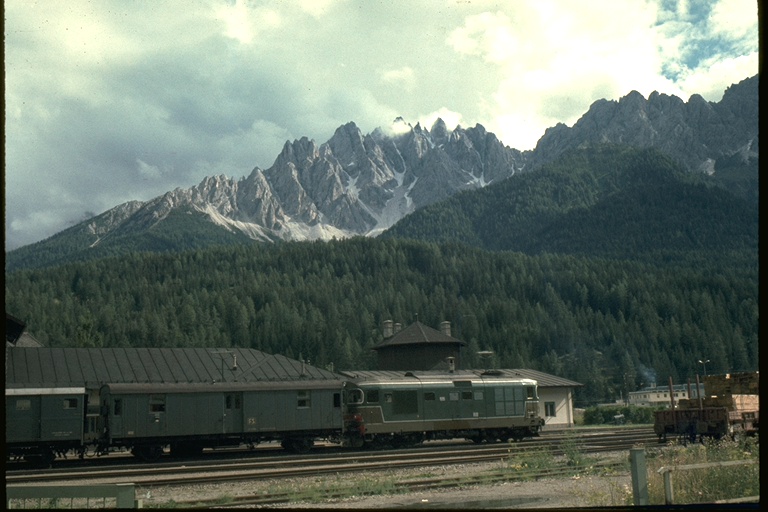
  After riding through Germany into Austria and Lichtenstein I ended up in Italy.  Instead of riding across the Alps mountains on the Simplon Pass, I decided to take the car-transporting train through the mountain tunnel.  


What the heck, a different adventure, right? 


  Welll, being a motorcycle, not a car, they directed me into a small box car.  Hmmm, I almost changed my mind but I had already paid for the ticket.   Probably safer than being on an open flatbed, right?  The side door was left open a bit, it was light in the boxcar, I put the BMW on the centerstand and leaned against the bike.

Small boxcar for motorcycles and bicycles through the train tunnel

   Eventually the train started moving, jerking a bit and slowly gaining speed, poking along into the mountain.  And then it got DARK!  In a boxcar, swaying side to side and jerking a bit front to back, with absolutely NO light, it was instant vertigo!  I almost fell over, having no reference to up or down.  Very near panic, I suddenly remembered the bike running light, turned on the ignition to the first position and had a dim light to see the walls and floor of the boxcar, that was a REALLY close call...  I probably should have ridden over the mountain pass for the scenery, but the train ride WAS different, hahaha.


  Stopped at the BMW shop in Andorra, between France and Spain in the Pyrenees Mountains, they put on my spare tires, did valve job on BMW, changed suspension springs, installed helicoils in the heads and new valve cover studs, did major service and tuneup, all for $125 !!! 

 To be continued :-)


Sunday, February 14, 2021

February 14, 2021 - No comments

Radio Communications In The Indian Ocean - 1974

 My job as a Cryptologic Tech (Maintenance) in the Navy (CTM2) had me going out on destroyers for a few months at a time in the early 70's.  Based in Rota, Spain, we would install an equipment shelter (called a QUIC Van) on a ship while they were in the Mediterranean, and eventually had one on a destroyer in the Indian Ocean.  Our gear inside was almost all receivers (VLF thru UHF) and a team of CT operators would monitor whatever/whoever there was in the area.  We usually had 2 CTR (Morse Code), 2 CTI (Linguists), 2 CTO (TTY Comm circuit ops) and CTT (ESM and other specialized systems) people on the team.  


  This was called DIRSUP (Direct Support) because the CT's on a ship were there to provide direct support to the operations of the ship,  using intelligence that the ship would otherwise not have access to.


The CTR's worked port and starboard watches 24 hrs a day, usually copying Russian ships, or CW signals from local countries in Africa, some were police nets on CW.  Being a ham that only used CW, I sometimes helped them by sitting their posit to give the ops breaks on the mid-watch (midnight shift), once they taught me the format they used for copying all the signals on a mill (an all upper-case typewriter).

For our own communications to the rest of the Navy we tied into the ship URC-32 1 KW output HF transceivers for our encrypted teletype (TTY) transmissions to a Navy shore station, using the other sideband of the URC-32 switched to DSB.  The ships used a UCC-1 frequency-division multiplex system to put sixteen 85Hz wide tone channels on each sideband.  Some channels were set aside for the NavSecGru to use.  

The Indian Ocean was a radio dead zone.  The I.O. wasn't a very strategic area for the Navy and the big shore stations (Rota and Guam) didn't have rhombic antennas aimed there.


Our CTOs (the CT teletype and comm circuit ops) would type up punch tapes of signal report messages to send to NSA and they would pile up for days at a time while the ship had no circuit with any shore station.  I went to the radio room to see what the Radiomen could do and was shocked to find them using a frequency list and just trying each freq, going up the list with no regard for time of day or propagation.  Trying to get a signal to Spain or Guam from the middle of the I.O. using 4 Mhz in daytime, or 19 Mhz at night, at the bottom of the sunspot cycle!  I tried to explain what bands would work but they had to go by some Navy procedure.  We would go for a week at a time with no communications to the rest of the Navy.  We were intercepting lots of new signals but couldn't send reports...

Photo of CTO at Model 28 ASR, with two Mod 28 UGC-20 receive-only printers to his right.

 It was spooky being on a ship that far out and not having any 2-way communications.  I could copy hams on the various CW ham bands 24 hrs a day but the ship couldn't get a teletype circuit up.  It was amazing and very frustrating.

On one TAD trip the ops woke me up early one morning at Oh-dark-thirty and said the Fleet broadcast TTY printer quit working.  I went into the van and there was a distinct shoe-print on the front of the UGC-25 gray cabinet (read-only teletype printer mounted in a rack 4 feet high). The E-3 O-brancher (CTO) got mad at it when the KWR-37 crypto receiver kept dropping out of sync because of the weak signals on HF shortwave. I had to splice the wiring at the rear that the motor fan had cut when he dislodged the cabinet with his foot.   It was so nice working with professionals :-(  He was one of them sent out with the team as punishment for screwing up back in Rota.


For more detailed descriptions of DIRSUP and QUIC Vans see the link below:

https://stationhypo.com/2021/04/20/quic-vans-guest-post/

A nice description of my job as a CTM3 on trips with the van:

"One of the most challenging Quic van positions was that of the CTM.  Typically filled by a single CTM3/CTM2 on his first enlistment, the mat man needed familiarity with 15-20 different pieces of equipment – receivers, crypto gear, teletype equipment, and auxiliary equipment such as tape recorders, typewriters and air conditioners. In addition to being a CTM, he also worked with ship’s interior communications technicians (IC) and electricians (EM) to ensure van connectivity.  Some assistance could also be provided by ship’s Radiomen (RM) and Electronics Technicians (ET), but in the end the repairs fell onto the shoulders of the mat man, since those other ratings were not cleared for van operations."

As the Maintenance Tech (a Navy E-4 rank) I was responsible for the van while transporting it to and from a ship, sometimes from Spain to Naples, Italy and other times to Athens, Greece,  always on a C-130 cargo plane.  To get a van on a ship in the Indian Ocean, we flew it to Bahrain (in the Persian Gulf) and it was installed on the destroyer USS Brumby there. I was assigned to stay with the van on the ship. After about 6 weeks the Brumby was leaving the Indian Ocean so the van had to be removed by crane in the port of Mombasa, Kenya,  and installed on another destroyer that was coming into the area.  The van and I sat on the dock most of the day with the door locked by a padlock with all the team's classified material inside.  The OIC (Officer In Charge) of the CT Team left me there while they all went to lunch, bar hopping, and souvenir hunting for the day.  I couldn't leave the van and waited for the other destroyer (the USS Paul) to come into port so I could arrange for a crane to load the van on the new ship.  Late in the day, no ship in sight, the OIC came back to the dock and apologized for leaving me there.  I won't mention his name here but I have not forgotten it.  Amazingly, 2 months later back in Rota, Spain, he requested ME as the CTM to go out with him on another team!  Fortunately I was a few months away from transferring to Edzell, Scotland and I didn't have enough time left at Rota to go out with his team again.

Three years later when my enlistment was up I was told that if I stayed in the Navy I would get another DIRSUP job because I did it well and had gotten good recommendations from the Officers I worked for.  That alone was enough to make me get out of the Navy at that point.

 Glenn AE0Q

Thursday, January 21, 2021

January 21, 2021 - No comments

Living In Southern Europe In The 1970's

 Traveling in foreign countries can be fun and/or challenging, depending on where you are going and where you're coming from :-)  But actually living in another country for a few years has different challenges.

  In 1972 I went from growing up in the U.S. in a suburb of St. Paul, MN to living in southern Spain. I was stationed there in the Navy and decided to live off-base, renting a house with another American, also in the Navy. We lived in a small village about 8 miles along the Atlantic coast from the Navy base.  I bought a 1971 Seat (pronounced SAY-aat), a Spanish-built Mini 1000, a small car with 10 inch wheels and a short stick shift that was perfect for driving on the twisting, narrow roads of the old Spanish cities.

  I don't intend for this description of life in Spain in 1972 to be mean or derogatory in tone, but life in this part of Europe was quite different from a medium size city in the US!  The house we rented was half a block down a dirt street from the 2-lane road along the coast. The family that owned the house moved into a smaller house they built on the property behind their 2 bedroom house we rented.

  Spanish houses and most buildings were built with red bricks, then a tile floor added. A groove was chiseled in the bricks of the walls for electrical wiring to be laid into, then plastered over. The wiring was about 1/2 the size of a light weight extension cord you would find in the US today.

  I don't know when electricity came to this part of Spain, but the power system couldn't handle much load. In the evening when people turned on lights in every house, the line voltage went down to 80 volts and lights were really dim!  As it got later in the evening the voltage would increase as people went to bed, and would climb to 140 volts or higher !!  Americans with their stereo systems were always blowing them up, the transformers in the stereo burned up because of the too-low or too-high voltage. 


  My roommate and I, being ham radio operators and electronics technicians for a living, had a Heathkit Line Voltage Monitor and a variable transformer for our stereo equipment.  Multiple times every evening we had to turn off the stereo, change the tap on the transformer to get 120 volts, then turn it back on.  One time we plugged in a vacuum cleaner we borrowed from someone. The vacuum cleaner drew enough power that it burned the small wiring that was plastered into the wall to the outlet, smoking it and leaving a brown line all along the walls to the main power connection. Oops, no more American appliances with THAT house wiring... 

   Heat in the fairly mild winters was from portable butane space heaters. Butane bottles (like bottled gas for barbecue grills) ran the stove and water heater, too.  The bathroom was pretty small, we frequently used our bathroom as a darkroom for developing 35mm film and printing pictures that we took while traveling.  We had an old Russian enlarger with a Nikkor lens for making the B&W prints.

  Spain was still ruled by Francisco Franco, the dictator that came to power in 1939 after the Spanish Civil War.  The Guardia Civil was the national police force and patrolled rural areas and highways.  They were usually just called 'Guardias' and always traveled in pairs, riding small motorcycles or 90cc mopeds.  They were always armed and had a small black leather box on the back of their duty belt.  We were told the box contained a small take-down submachine gun, although I never saw a Guardia deploy one in anger.  The coast areas of southern Spain were known for lots of smuggling and the pairs of Guardia were always seen patrolling local roads and beaches.  The Navy warned us to NEVER walk on the beaches at night as that was inviting being shot by the Guardia first, with questions asked later.  The Guardia Civil was mostly feared by the local populace and people always deferred to them, although they were always very polite when foreigners talked to them or asked questions.  A Guardia and his family lived down our road a few houses, none of our neighbors ever looked at him or spoke to him but he was always friendly to me. One time I asked a Guardia (in Spanish) if it was OK to go into the old WW2 concrete gun bunker on the beach near our house, he laughed and said sure, go ahead, probably amused by the silly American climbing in there with the stagnant water and rats.  The Spanish coast had lots of big bunkers left over from WW2, it had only been 27 years since the war ended.

   The Guardia Civil uniform acquired the tri-corner hat in the 1800's.  We were told the version worn with the flat, turned-up back was symbolic of the Spanish civil war in 1938 when Franco and the Guardia had their "backs to the wall" but eventually won.  I have since read that it goes back to the Spanish people and police being shot against walls by Napoleon's army, but never giving up.  Whichever, their hat has been symbolic of a powerful police force.


  Houses in our part of Spain didn't have screen doors, many people just left their front doors open when they were home until they went to bed.  Neighbors could frequently be seen talking, or more likely shouting gossip to each other, from house to house along the street and kids played in front of the houses. Like much of Europe, the fronts of houses bordered the street, each house adjacent to the next.  I don't remember how trash was eventually collected, but household garbage was deposited outside the front door of the houses, along the street. To keep rats away, rat poison was liberally applied to the piles of garbage. 

  My roommate Paul and I and another friend in the Navy, Gil, adopted two dogs from a litter in 1973.  Gil named his female puppy Cory, we named our male puppy Bo.  They were medium-size and mostly white with some black spots.  The dogs were always underfoot and were very gregarious.

  Our dog Bo was funny, he couldn't jump.  He liked to sleep in my bed with me at night and I had to help him up onto the bed, he just couldn't figure out how to jump!  

  My job in the Navy entailed working on various ships for a few weeks to a few months at a time, so when I was gone Gil and Paul would help take care of both dogs.  One time when I was gone Bo was at Gil's house for a while.  Gil wore cowboy boots with a hard heel, and accidentally stepped on Bo's leg and crushed the bone.  They took Bo to the American vet on the Navy base (a LARGE Navy base!) and the vet screwed a metal plate to the bone sections to hold it together.  When I got back from my trip working on a ship Bo was completely healed.

  An amazing result of Bo's injury and recovery was that he could JUMP !  When I went to bed he just hopped right up in the bed with me :-)

  We had been warned not to let Bo out to run around as there were no stray dogs in Spain.  The joke was that they became tapas (small plate of snacks served in local bars), but more likely they got into the rat poison.  We were always really careful when coming home to keep Bo on a leash and no running loose, but of course it had to happen once.  In those few seconds he must have grabbed something with rat poison from a neighbors trash pile.  

  Bo started to get blisters on his skin, his nose and pads of his feet.  Of course this happened when the American Navy vet was in the US on leave in late 1974, so we were told to take him to the Spanish vet in Rota, the town next to the Navy base.  It turned out that the vet's office was in the middle of the big slaughterhouse for the meat packing industry.  Paul and I took Bo into the vet, I carried him through a huge white room with long racks of beef carcasses hanging from the ceiling, blood all over the floor.  The vet looked at Bo and said yes, he had eaten rat poison and there was nothing that could be done,  we could leave Bo there and he would, well, take care of it.

  That vets office was the most disgusting place I had ever been in so far in my life, and there was no way Paul or I were going to leave our dog with that vet !!  Paul and I looked at each other and we got out as fast as we could, horrified at the thought of leaving Bo there.  With no other vet to go to, we had to put our dog, Bo, to sleep ourselves.  Being guests in a foreign country we didn't have any guns.  The only thing we came up with was to put Bo to sleep using gas from a butane tank.  We got a large cardboard box and a butane tank and drove east on a dirt road into the countryside.  There were lots of open fields along dirt roads in this agricultural part of Spain.  We stopped at an isolated field, put Bo in the box with the hose from the tank and turned it on.  We had to hold the box closed and he did struggle for a bit.  We buried Bo in the field.

  Many Americans that were stationed at the Navy base at Rota had a great time.  The weather was mild, there were lots of bars with good food, music and plenty to drink for the party crowd.  It was generally a nice place to be, with nearby cities to go sightseeing and beautiful, ancient historical places to see.  Some ex-Navy Americans even live in southern Spain now.  But for me, that experience with the Spanish vet and our dog has been the most horrible thing that has ever happened to me, and it stays with me to this day.

Thursday, July 2, 2020

July 02, 2020 - 2 comments

Ham Radio CW and the Russians (1969)

I've finally written about what I did on the air in high school...

1969, White Bear Lake, Minnesota  -  I had just gotten my General class ham license and was 16 yrs old, and a CW (Morse code) fanatic.  I was using an old home-made tube-type keyer that some older ham gave me with a pair of straight keys bolted back to back for a squeeze paddle to send Morse code.  I had a Johnson Ranger 2 transmitter and Hammarlund HQ-110AC receiver and a 40m dipole antenna in the back yard of my parents home.  Late at night when the ham band got empty I would tune around below 40m and discovered the Russian ship-to-shore traffic nets using Morse code.  The net control shore station was usually sending 30 wpm or faster and it was fun to listen to  the ships check in.  I figured out that it was Russians from the ITU assignments of the callsigns.  When there were no hams on 40m to work, I wanted to see if the Russians could work me, DX on 40m !  So I would listen to the QTC tape and then break them and check in with the call of one of the ships they had traffic for.  Sure enough, they always heard me in Minnesota and sent me down freq to get the traffic.  But it was almost always below the range of the Ranger VFO, I couldn't meet the op and after a few minutes of calling me the net control would call again on the main freq.  I'd answer, he'd speed up a bit and be annoyed and send me down freq again, and by the third time they would finally ignore my signal, recognizing my fist.  But at least I knew I could work DX on 40m !  I did this off and on for a couple of years.


I graduated from high school, went to college for a year, and in 1971 enlisted in the Navy in the Advanced Electronics Program.  I was selected for a security clearance and became a CTM3 (Cryptologic Tech, Maintenance) and finished Electronics Technician school on Treasure Island, then schools for KW-7 Crypto at Mare Island, CA and Model 28 Teletype machines in Norfolk.  After 2 years of duty at the Naval Security Group HFDF site at Rota Spain (see blogs about Sahara Desert and Indian Ocean) I ended up at the Navy HFDF site at RAF Edzell in NE Scotland.  The building we worked in was inside the huge Wullenweber antenna array.  There were about 14 Navy HFDF sites around the world linked by real-time encrypted Teletype circuits (this was in the 60's and 70's !!).


1976 - I was on CW on the ham bands a lot from Scotland in my off duty time (Drake R-4A/T-4X, Heathkit SB-220) and could copy 45 plus wpm.  My call there was GM5BKC.  At work (a CTM2 in the Navy) I repaired teletype equipment and we worked in some areas of the receiver building where the ops copied all Russian teletype signals (a system called TEBO). 

 More teletype equipment was in other areas where the CTR ops (the ones taught to copy Morse Code) monitored the Russian ship-to-shore CW nets.  When a ship checked into the net, they would copy the callsign and get a DF cut on the signal, which would then lock in all the other HFDF sites around the world to the same frequency to all get a DF cut on the signal, if it could be heard.  Spots of new signals came over our teletype circuits.


 Every 3 months the Russians would change the
frequencies they used as the bands opened and closed each day, to confuse us, so the HFDF ops would be really busy for a while searching the bands (R-390A and SP-600 receivers) and finding all the new frequencies.  Every Russian ship, cargo ships and especially "fishing trawlers" (intelligence collection ships), were considered  military vessels and were kept track of on the radio.

 
  One night on a mid-watch a Mod 28 printer broke at the HFDF CW posit and I replaced the 'typing unit' with a spare from the Teletype Maintenance shop.  

I asked the CTR op working the posit when there would be some traffic on the teletype circuit so I could be sure the teletype printer was working, and he said we just had to wait until one of the other HFDF sites heard a new CW signal and the spot came over our secure TTY net.  So I stood around for a while, listening to the CW net he was monitoring on a big speaker hanging from the top of the equipment rack.  The Russian shore station net control was being a real jerk, not slowing below 30 wpm, no matter how slow or ragged the shipboard operators were sending.  One poor guy on a ship, probably bouncing around in the North Atlantic, could barely send anything you could copy and the net control rudely chewed him out on the air (on CW, of course)!  I turned to the CTR and said "man, that net control sure is being an asshole".  Wow, our op turned to me and half way fell out of his chair, he was so shocked that a Matman (what they called us CTM Maintenance techs) could copy CW.  "You can copy that in your head?  He's doing 40's ?! (Navy term for going 40 wpm).  You've been copying the whole thing?".  I just told him sure, I'm a ham and I only use CW, 40 wpm isn't really that fast...

  Well, once I had listened to the HFDF ops for a while I realized what they had been doing every day and night on the radio for the last 15 or 20 years.  They obviously knew where I was located every single time I hit the key and sent one of those callsigns on the Russian net when I was in high school, and I hope they got a laugh from my messing with the Russians :-)   I was surprised that the FBI never showed up at our door in Minnesota, asking why I was using a Russian callsign, but of course to ask that question would give away that someone knew, and our HFDF capabilities were Classified for many decades.

Glenn AE0Q (ex WA0VPK, GM5BKC, ZB2WZ)
ex-CTM2 USN

More about Cold War spy ships (photo)

Friday, June 26, 2020

June 26, 2020 - No comments

Getting Stuck In The Sahara Desert


 When I was in the US Navy stationed in Spain in the early 70's, I made 5 trips to Morocco with a friend, we were both Amateur Radio operators and thus intrigued by foreign countries and cultures.  We spent most of our 30 days annual leave from the Navy traveling around Morocco two years in a row, 1973 and 1974, although in '74 we also went to Gibraltar for a week to operate ham radio there.

  The travel guide "Spain And Morocco On $5 And $10 a Day" was our bible.  We were usually in Morocco other than the peak tourist season and we could haggle with hotel clerks for a cheap rate for a few nights.  The guide book told us which ones to try.  I remember it said that tourists should never go into the souk in Marrakesh, Casablanca or Tangiers after dark.  So of course we had to do it, late at night, in all of them :-)

  The other idiot thing we did in 1974 was drive the car out to the desert from Marrakesh, instead of taking a Sahara tour in one of the big 6WD buses.  The tours all left at 4AM so they would be back before the heat of the day, but we left at 8AM.  We drove east across the Atlas Mountains and into the desert as far as the hard packed sand track went.  Got to the end where sand dunes started and saw camels wandering around.  Turned around and started back, late in the morning.  It was getting hot.  We had a Sony shortwave radio installed in the car, I was tuning the bands.  On the FM broadcast band the entire dial was packed with BBC and German stations, coming in like we were next door to them!  It was May and they were coming in via Sporadic E skip propagation on VHF from northern Europe to Morocco, it was awesome!  My roommate Paul (then WA3IJR) was driving, he looked down at the radio in amazement and drove off the hard packed track.  The VW Fastback sedan was stuck in the sand.  We had a 1 gallon jug with only a cup of water in it, and an old British Army poncho we draped across the windshield for shade, all our luggage was back in the hotel in Marrakesh.

  We took turns digging out the sand in front of the back wheels, then pushing and driving the car a few feet, then resting and doing it again.  Hours went by doing this, at mid-day, at the edge of the Sahara Desert.  We figured we would be stuck until the next morning when the tourist buses came back.  Around 3PM we saw an old wizened Moroccan man pushing a bicycle across the desert at right angles to the "road", we waved to him and he came over to us.  He didn't speak Spanish or French or English.  He had a water bottle with burlap tightly sewn around it, he opened the bottle, flicked it just right and a tiny bit of water came out and got the burlap wet, cooling the water in the bottle. He offered us both a bit, cold water in the middle of nowhere!  Then he went to the track and started pulling up weeds growing along the edges.  We couldn't figure out what the heck he was doing until he came back to the car and started laying them in front of the wheels and kicking them into the sand, under the tires with his bare toed sandals.  We got the idea, ran up and pulled all the weeds we could find, making a track ahead of the car.  With two of us pushing and one driving, the VW used the weeds for traction and easily drove out and up to the hard packed track.  The old Moroccan wouldn't take any money for thanks, he just left pushing his bicycle off across the sand.

  We were still really thirsty and the first thing we came to on the way back was a mud brick hut along the sandy track.  They were selling warm bottles of Coca-Cola, it was better than nothing!  Coca-Cola never tasted so good :-)  I had thought to fill a paper grocery bag in the trunk with sand from the desert while we were stuck and I still have 4 Coke and Pepsi bottles, with Arabic writing on them, full of Sahara Desert sand :-)

 
  It was 10PM by the time we were driving over the Atlas Mountains back to Marrakesh (and the hotel with our belongings) and encountered very dense, solid fog.  We could only see the narrow road by my leaning out the passenger window and shining a flashlight on the road edge, creeping along.  We were exhausted when we finally got back to the hotel.

  We had fun exploring the Roman ruins in Morocco on our trips, the best being in Volubilis with the many mosaic tiled floors and walls (2000 years old!!).


And of course the famous sculpture in the middle of the brothel :-)


The perfectly straight Roman road into the city is an awesome view.  We encountered very few other tourists in 1973-74.


Wednesday, June 24, 2020

June 24, 2020 - No comments

My start in radio

  When I was 7 or 8 years old my grandparents had a big console radio in the front room of their house in St. Paul, Minnesota.  I was fascinated by all the cities and countries that were listed on the shortwave bands of the radio dial.  I used to sit for hours and listen to radio stations, trying to figure out where they were.  My Dad's parents lived a few miles from us so we visited them a lot.

  About that time we moved into a new house in White Bear Lake (1959), my father helped customize some of the early construction (he was a Civil Engineer).  He wasn't into shortwave listening himself, but thinking ahead he ran a wire from one end of the house to the other in the attic, with a single connected wire running thru the walls down to the basement.  My younger brother and I shared one of the 3 bedrooms upstairs. When I was 10 yrs old my Dad finished a bedroom in the basement at the other end of the house from the upstairs bedrooms, and I got my own room !  One of his engineer friends sold me an almost-new Hallicrafters S-120 general coverage shortwave radio for $20  (he almost gave it away!!), it was connected to the attic antenna and I became addicted to radio :-)

  I discovered jazz music by listening to the weekly Voice Of America Jazz Hour on the shortwave bands.  I sent SWL (Shortwave Listener) reports to many foreign broadcast stations, and would get Christmas cards every year from Radio Moscow and Radio Havana (Cuba) for years after.

  While tuning the shortwave bands I came across a REALLY strong signal, it was Tony W0KVO on 75m AM ham radio.  One of my Dad's friends was a ham operator and gave me a Callbook, as big as a Sears catalog, a way to look up every US Radio Amateur and get their address.  Tony lived less than a mile from us,  I rode my bicycle to his house and introduced myself.  He was a mentor to me in electricity, electronics and ham radio.

  When I was 15 yrs old Tony gave me and a neighbor the FCC tests (Morse code and written) for the Novice class Amateur Radio license and a few weeks later I received callsign WN0VPK, in September 1968.  Six months later on an early Thursday morning I went with my father on his way to work in downtown St. Paul and took the FCC General Class test.  I became WA0VPK.  Six months after that I took the Advanced Class test at the same FCC office and passed that :-)


WA0VPK Station in early 1969
 Hallicrafters SX-140, Eico 723 with 722 VFO, homemade TO keyer and vacuum-tube T/R switch for QSK CW.


With a bit of trading and repairing radios I ended up with a better station, a Hammarlund HQ-110 and Johnson Ranger-2, QSK CW.


WA0VPK station in 1969


Friday, May 15, 2020

May 15, 2020 - No comments

Vaguely Connected Thoughts

This is a collection of random, but somewhat connected thoughts, mostly a result of my travels while in the Navy, after the Navy, or related to Amateur Radio.  People used to, and probably still do write these things in a journal.  I wonder how many are tucked away in closets or basements.  Maybe some of this will see daylight and be read.

  Glenn AE0Q (ex GM5BKC, ZB2WZ, V31RY, WA0VPK)